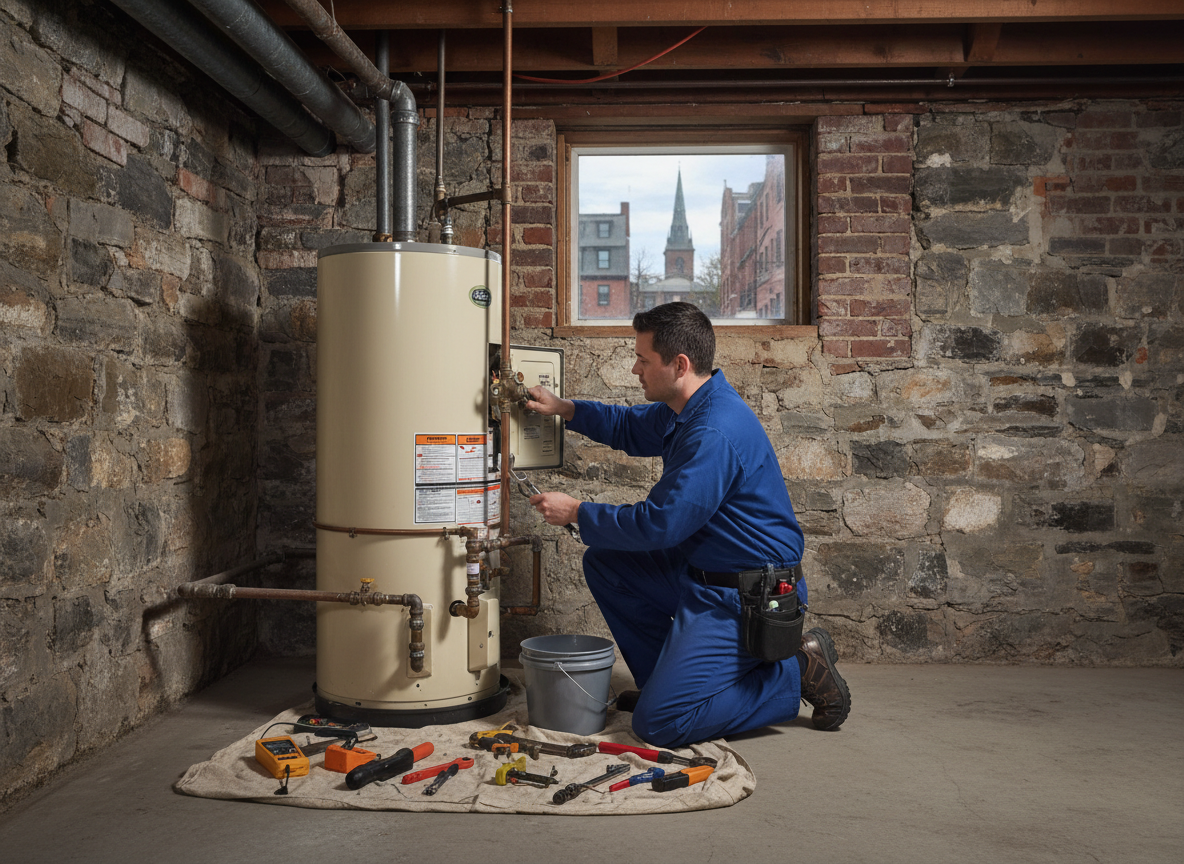
Boston's housing stock from the 1800s and early 1900s in Beacon Hill, Back Bay, and the North End often features tight basements and galvanized piping that accelerates sediment buildup in tanks. Regular flushing removes mineral deposits carried by city water, which the Atlantic-moderated humid continental climate does not fully prevent from settling during milder shoulder seasons. Skipping this step leads to reduced efficiency and premature element failure in electric units common in South End row houses.
In neighborhoods like Jamaica Plain, Roxbury, and Dorchester, water heaters installed in unconditioned spaces face greater corrosion risk from humidity drawn off Boston Harbor. Technicians inspect anode rods and temperature-pressure relief valves on every visit because older vent systems in these homes can trap moisture against the tank exterior. This targeted check prevents leaks that travel through shared walls in multi-family buildings.
Cambridge and Somerville homes near the Charles River see similar issues with hard water scaling on thermostats. Maintenance includes calibrating controls and verifying proper venting to meet current Massachusetts fuel gas code requirements without unnecessary upgrades. Homeowners in Allston and Brighton benefit from pre-winter visits that catch expansion tank problems before freeze-thaw cycles stress connections.
Technician insight
In Boston, the thing that catches most people out with water heater maintenance is how quickly sediment accumulates in pre-1950 homes in Roxbury and Dorchester because the city water carries more minerals than newer suburbs expect, and those tight basements make full flushes slower than jobs in Cambridge or Brookline.
Sediment Blockage in South Boston
A homeowner in South Boston noticed inconsistent hot water during early winter. Inspection revealed heavy sediment in a 12-year-old electric tank installed in a damp basement near the harbor. The technician performed a full flush, replaced the degraded anode rod, and tested the TPR valve. Hot water delivery stabilized and no further issues appeared that season.
Water Heater Maintenance Services We Offer
✓Tank Flushing and Sediment Removal
Removes mineral buildup that shortens tank life in Boston's older municipal water system, restoring efficiency in homes across the South End and Charlestown.
✓Anode Rod Inspection and Replacement
Checks and swaps sacrificial rods to slow corrosion accelerated by humid air near Boston Harbor and in unheated basements of Beacon Hill properties.
✓Temperature Pressure Relief Valve Testing
Verifies valve function to prevent dangerous pressure buildup common in aging systems found throughout Dorchester and East Boston.
✓Thermostat Calibration Service
Adjusts and tests thermostats for accurate temperature control, reducing energy waste in variable winter conditions across Brighton and Allston.
✓Expansion Tank Check and Adjustment
Inspects and repressurizes expansion tanks to protect pipes in tight spaces typical of North End and South Boston row houses.
Water Heater Maintenance Cost in Massachusetts
| Service | Typical Range | What Affects It |
|---|---|---|
| Standard Tank Flush and Inspection | $150–$275 | Higher in tight Beacon Hill or North End basements with limited access. |
| Anode Rod Replacement Add-On | $90–$180 | Varies by rod length and whether tank requires partial draining. |
| Full Maintenance Package | $225–$375 | Includes multiple checks; price rises with electric vs gas units or multi-story homes. |
Ranges are typical for Massachusetts and confirmed with an exact written quote before any work starts.
How it works
- 1
Site Assessment
Technician evaluates tank location, access, and visible condition in the specific Boston neighborhood home.
- 2
System Isolation and Safety Check
Shuts off power or gas and confirms no active leaks before opening any valves or panels.
- 3
Maintenance Procedures
Performs flushing, rod inspection, valve testing, and calibration as needed for the unit type.
- 4
Final Verification
Restores service, confirms proper operation, and notes any future concerns for the homeowner.
Pricing
Maintenance pricing reflects tank access difficulty in older Boston buildings and time required for thorough checks.