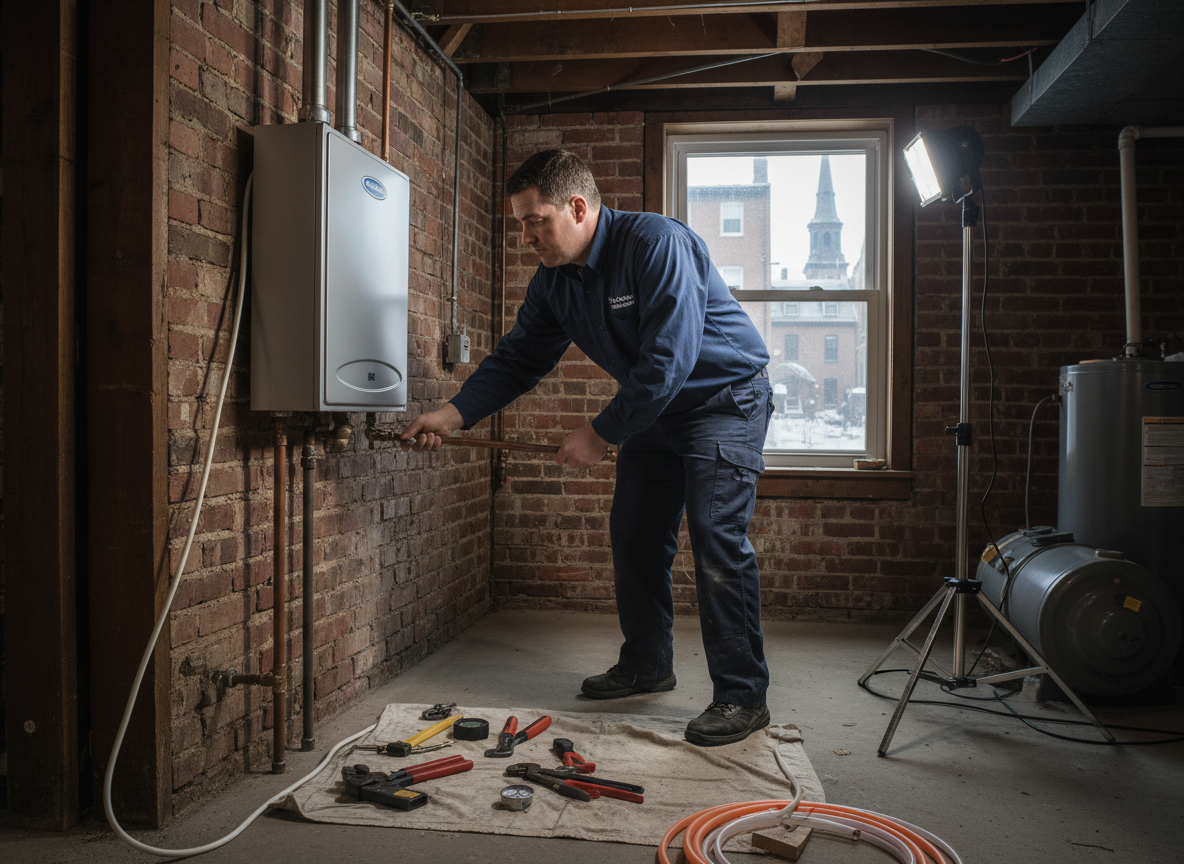
Boston's housing stock in neighborhoods like Beacon Hill and the North End often features 19th-century piping runs and limited mechanical closets that complicate tankless retrofits. Installers must evaluate existing gas line diameter and venting paths before committing to a unit, since undersized lines in these buildings commonly require upsizing to maintain proper flow rates during peak winter demand. Coastal humidity and salt air also accelerate corrosion on exterior vent terminations, so stainless steel components rated for marine exposure become necessary in East Boston and Charlestown.
Suffolk County permitting requires combustion air calculations and seismic strapping even for interior units because of the region's freeze-thaw cycles. In South Boston and Dorchester triple-deckers, shared utility walls mean noise isolation and condensate drainage routing must be coordinated with neighboring units to avoid callbacks. Technicians routinely discover galvanized steel lines that restrict flow to tankless units, forcing partial repiping through finished ceilings in Jamaica Plain and Roxbury homes.
Nearby Cambridge and Brookline properties add another layer: many post-war apartments have electric service panels that lack capacity for high-draw electric tankless models, steering most jobs toward gas units with dedicated 3/4-inch or larger supply lines. Proper condensate neutralization is essential here because acidic discharge can damage older cast-iron stacks common in the area.
Technician insight
In Boston the thing that catches most people out with Tankless Water Heater Installation is discovering 3/4-inch or smaller galvanized lines running through finished ceilings in South End and Jamaica Plain homes; those lines must be replaced before the unit will deliver rated flow, especially once winter groundwater temperatures drop.
Beacon Hill brownstone retrofit
Homeowner requested tankless conversion in a four-story Beacon Hill building with existing 1/2-inch gas lines. Assessment showed insufficient capacity for simultaneous shower and kitchen use. Crew replaced the main gas run through the basement and installed a properly vented unit on an interior wall, restoring full hot water delivery without disturbing historic finishes.
Tankless Water Heater Installation Services We Offer
✓Gas Line Sizing for Tankless Units
Measure and upgrade gas piping in Back Bay brownstones to deliver consistent BTU supply without pressure drops during simultaneous fixture use.
✓Electric Tankless Installation in Historic Homes
Install high-efficiency electric models in Beacon Hill and South End properties where gas lines are absent or restricted by landmark rules.
✓Condensate Neutralization and Drainage
Route and neutralize acidic condensate in older Suffolk County buildings to protect cast-iron and copper drain lines from corrosion.
✓Venting Through Brick and Masonry Walls
Core drill and seal stainless vents in Charlestown and North End row houses while preserving structural integrity and weatherproofing.
✓Multi-Unit Tankless Conversion
Convert shared systems in Dorchester and Roxbury triple-deckers to individual tankless units with separate metering and isolation valves.
Tankless Water Heater Installation Cost in Massachusetts
| Service | Typical Range | What Affects It |
|---|---|---|
| Basic gas tankless swap | $2,800–$4,200 | No major piping changes required |
| Gas line upsizing | $1,100–$2,600 | Common in Beacon Hill and Back Bay |
| Electric tankless install | $2,400–$3,900 | Panel upgrade often needed in older homes |
| Venting through masonry | $650–$1,400 | Core drilling and sealing in brick structures |
Ranges are typical for Massachusetts and confirmed with an exact written quote before any work starts.
How it works
- 1
Site Assessment
Inspect gas or electric service, existing piping, and vent routes in the specific Boston neighborhood to identify required upgrades.
- 2
Load Calculation
Calculate peak demand based on household size and fixture count, factoring in colder incoming water temperatures from the Atlantic-influenced supply.
- 3
Permitting And Material Staging
Pull Suffolk County permits and stage corrosion-resistant venting and piping sized for the building's age and construction type.
- 4
Installation And Testing
Mount the unit, connect upgraded lines, verify combustion air, and test flow at multiple fixtures under winter conditions.
Pricing
Pricing varies with gas line upgrades and venting complexity common in pre-war Boston buildings.